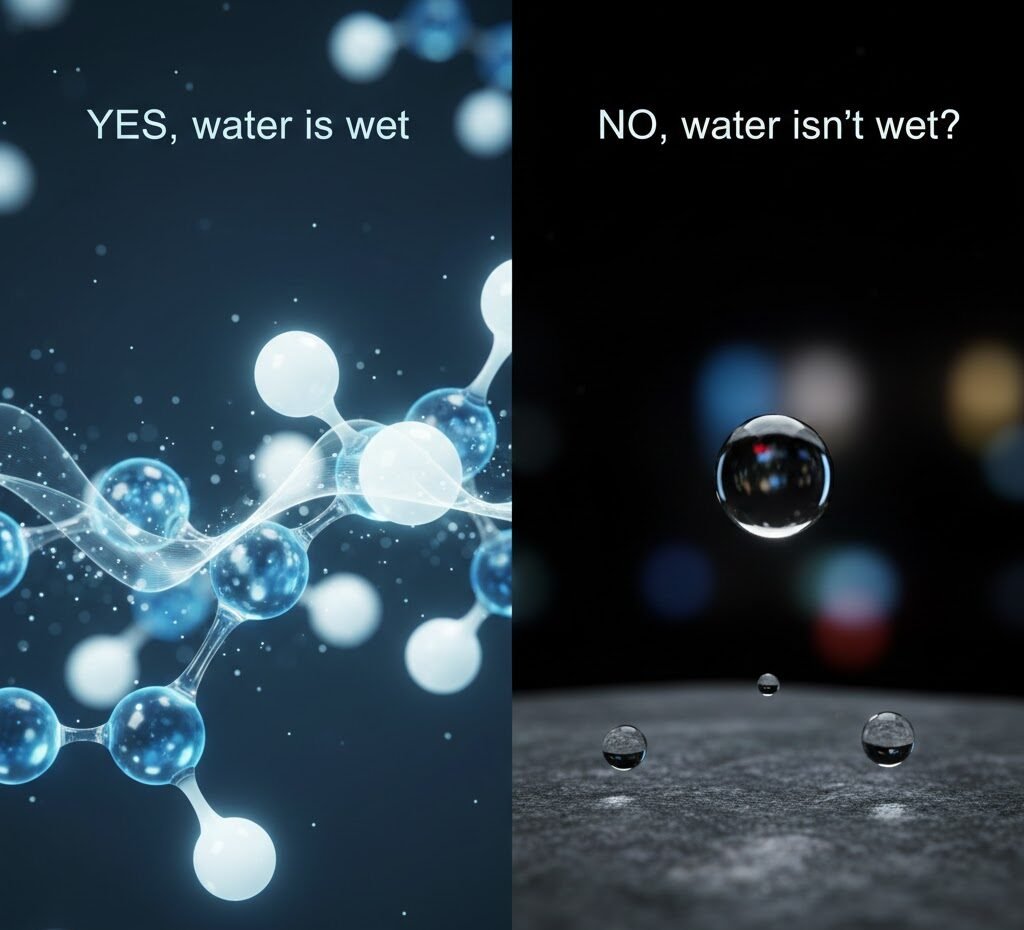
Is Water Wet
The Big Debate: Is Water Wet?
Have you ever sat around with friends and asked a question that started a huge argument? One of the most famous questions today is simple: is water wet? It sounds like an easy question at first. Most people say, “Of course it is!” But then, someone else will say, “No, water makes things wet, but it isn’t wet itself.” This debate has taken over the internet. It has moved from school lunchrooms to big science labs. Everyone seems to have a very strong opinion on the matter.
In this article, we are going to look at both sides of the story. We will use simple science and clear logic to find the truth. We want to understand what “wetness” really means. Is it a feeling? Is it a scientific state? Or is it just a trick of the English language? By the end of this guide, you will be the expert in your friend group. You will have all the facts needed to win the next time someone asks, “is water wet?”
Understanding the Definition of Wetness
To answer the question, we first have to agree on what “wet” means. Most dictionaries say that being wet means being covered or soaked with a liquid. For example, if you spill juice on your shirt, the shirt is now wet. The juice has stuck to the fibers of the cloth. This is where the confusion starts for many people. If wetness is the act of a liquid sticking to a solid, then water cannot be wet. This is because water is a liquid, not a solid object.
However, other people think about it differently. They believe that wetness is a physical property of the liquid itself. In their eyes, water is the very essence of wetness. You cannot have wetness without a liquid. Therefore, they argue that water must be wet by its very nature. This clash of definitions is exactly why the debate lasts so long. We have to decide if we are talking about how we feel things or how molecules behave under a microscope.
The Scientific View of Liquid Molecules
When we look at water through a powerful microscope, we see billions of tiny molecules. These molecules are made of hydrogen and oxygen. They are always moving and sliding past each other. The key to the “is water wet” debate lies in how these molecules stick together. Scientists call this “cohesion.” Cohesion is the force that keeps water drops in a round shape. It is why water clumps together on a windowpane during a rainy afternoon.+1
Because water molecules are always touching other water molecules, they are “covering” each other. If being wet means being covered by water, then every molecule in a glass is technically covered by its neighbors. This scientific view suggests that water is indeed wet. It is essentially “soaking” itself all the time. This is a very strong argument for the “yes” side. It moves the debate away from just how we feel things and looks at the actual structure of the liquid.
Adhesion vs. Cohesion Explained
To really get deep into the question, we must look at two big words: adhesion and cohesion. Cohesion, as we mentioned, is water sticking to water. Adhesion is water sticking to other things, like your skin or a towel. When you get out of a swimming pool, you feel wet because of adhesion. The water molecules are clinging to your body. If water didn’t have adhesion, it would just slide off you perfectly, leaving you dry like a duck’s feathers.
So, the question “is water wet” often turns into a choice between these two forces. If you think wetness is only about adhesion, then water isn’t wet. It only makes other things wet. But if you think cohesion counts, then water is the wettest thing there is! Most scientists prefer to use these specific terms instead of the word “wet.” It helps them avoid confusion when they are doing important experiments in the lab or studying the ocean.
Why We Perceive Water as Wet
Humans don’t actually have “wetness” sensors on our skin. Our brains are very clever, but they have to guess when we are wet. We use a mix of temperature and pressure to figure it out. When you touch a cold, slippery liquid, your brain combines those feelings. It then sends a signal saying, “Hey, this is wet!” This is why sometimes a very cold piece of metal can feel wet for a split second, even if it is dry.
This human perception adds another layer to the “is water wet” mystery. Since wetness is a sensation we create in our minds, it is subjective. If you feel that water is wet, then for you, it is. But science tries to look past our feelings. It looks at the facts of the physical world. Even if our brains tell us one thing, the physics of the molecules might tell us something else entirely. This is why the debate is so much fun to talk about.
The Role of Surface Tension
Have you ever seen a small bug walking on top of a pond? That bug is using surface tension. This is a special “skin” on the top of the water caused by molecules sticking together tightly. Surface tension is a huge part of the liquid experience. It is what keeps water from just spreading out into a thin, invisible gas. It holds the liquid together so that it can interact with the world as a solid-ish mass.
Some people argue that this surface tension proves that water is a single unit. If the whole body of water is one thing, it can’t really be “covering” itself. In this view, water is just a substance that has the power to wet other surfaces. It acts as a tool for wetness. When you break the surface tension, you allow the water to coat a new object. This is a very logical way to look at the problem. It helps explain why we use water to clean things or to hydrate our skin.
Can a Single Molecule Be Wet?
Let’s take the question to the smallest level possible. Think about just one single water molecule all by itself in space. It has no neighbors. No other water is touching it. In this case, almost everyone agrees that this single molecule is not wet. It is not covered by anything, and it isn’t sticking to anything. This helps us realize that wetness is a “bulk property.” This means it is something that only happens when you have a lot of a substance together.
This changes the way we ask, “is water wet?” Maybe the answer depends on how much water you have. A single drop has millions of molecules covering each other, so it could be wet. But a lone molecule is just a tiny piece of matter. This shows that wetness is about the interaction between particles. It isn’t just a label we can slap on a single atom. It is about the community of molecules working together to create the liquid state we see in a glass.
Comparing Water to Other Liquids
Water isn’t the only liquid on Earth. We have oil, mercury, and even liquid gold. Does the question change for them? If you dip your hand in oil, you definitely feel “wet” in a greasy way. But if you dip your hand in liquid mercury, it doesn’t stick to you at all. It stays in a ball and rolls off. Even though mercury is a liquid, most people would say it doesn’t feel wet. This is because it has very high cohesion and very low adhesion to human skin.
This comparison helps us see that “wet” is a word we mostly use for water and similar liquids. It proves that wetness is about the relationship between a liquid and a surface. If the liquid refuses to stick, we don’t call it wet. Since water is very good at sticking to almost everything, we associate it with wetness more than any other substance. This is why the question “is water wet” is usually about water and not about milk or gasoline.
The Linguistic Side of the Argument
Sometimes, the problem isn’t science at all. It is just the English language. Words can be very tricky. We use the word “wet” as both an adjective and a verb. You can “wet” a towel, and then the towel is “wet.” In English, we often use adjectives to describe the state of an object after something has happened to it. A “burnt” piece of wood is wood that has been touched by fire. Fire itself is not “burnt.” It is the source of the burning.
Following this logic, water is the source of wetness. It is the “fire” in this example. If fire isn’t burnt, then water isn’t wet. It is simply the thing that causes the state of being wet in other objects. This is a very popular argument for the “No” side of the debate. It relies on how we structure our sentences and how we define the roles of different words. It shows that sometimes, science and grammar don’t always agree on the same answer.
Practical Examples of Wetness in Daily Life
Think about your daily routine. When you wash your hands, you want the water to be wet so it can carry away dirt. If water weren’t “wet” (meaning, if it didn’t stick to things), it wouldn’t be very useful for cleaning. We also see this in cooking. When you boil pasta, the water enters the noodles and changes them. The noodles become wet and soft. In these cases, we focus on what the water does, not what the water is.
However, consider a rainy day. We say “the rain is wet.” We don’t just mean the ground is wet; we mean the falling drops themselves. When a drop hits your face, the sensation is immediate. In our everyday speech, we use the phrase as a way to describe the experience of the weather. This common usage makes it very hard for people to accept that, scientifically, the answer might be “No.” We have been taught since we were toddlers that water and wet are the same thing.
The Consensus: What Do Experts Say?
If you ask a chemistry teacher, “is water wet?” they might give you a long answer about molecular bonds. Many scientists lean toward the “No” side. They prefer to say that wetness is a description of how a liquid interacts with a solid. However, some physicists argue for “Yes.” They believe that the internal interactions of water molecules count as wetness. There isn’t one single “official” answer that everyone in the world has signed off on.
This lack of a final answer is actually a good thing. It encourages people to think critically. It makes us look at the world with more curiosity. Whether you choose “Yes” because of cohesion or “No” because of linguistic rules, you are learning how to build an argument. The question has become a tool for teaching people about physics and logic. It proves that even the simplest things in our lives can be much more complex than they seem at first glance.
Frequently Asked Questions
1. Is water wet or dry? Water is definitely not dry! Dryness is the total absence of liquid. Since water is a liquid, it can never be dry. The real debate is whether it is “wet” or if it is just a “wetter” of other objects. Most people agree it sits in its own category as a liquid.
2. Why do people say water isn’t wet? People who say water isn’t wet usually point to the dictionary. They argue that wetness is what happens when a liquid sticks to a solid surface. Since water is not a solid, it cannot be “covered” in the way a shirt or a dog can be covered.
3. Does water make itself wet? This is the heart of the “Yes” argument. Because water molecules are always sticking to each other through cohesion, they are essentially “wetting” each other. If you have a group of water molecules, they are all covered by their neighbors, which fits the definition of being wet.
4. Can you be wet underwater? This is another fun brain teaser! When you are completely underwater, you are fully covered by liquid. By every definition, you are wet. However, you might not feel the “sensation” of wetness until you get out and the water starts to evaporate or move against your skin.
5. What is the “wettest” liquid? In science, we look at “wetting agents.” These are liquids that spread out the most on a surface. Water has high surface tension, so it sometimes beads up. If you add soap to water, it lowers the surface tension and makes the water “wetter,” allowing it to soak into things much faster.
6. Is there a scientific name for the “is water wet” debate? There isn’t one official name, but it falls under the study of “Fluid Dynamics” and “Surface Science.” These fields look at how liquids move and how they touch different materials. It is a very important area of science for things like medicine and engineering.
Conclusion: The Final Word on Wetness
So, after looking at the science, the language, and the feelings, what is the answer? Is water wet? The truth is that it depends on your perspective. If you are looking at it through a microscope and seeing molecules sticking together, it is very easy to say yes. If you are a grammarian looking at how we use words to describe objects, it is very easy to say no. Both sides have great points that make sense.
About the Author