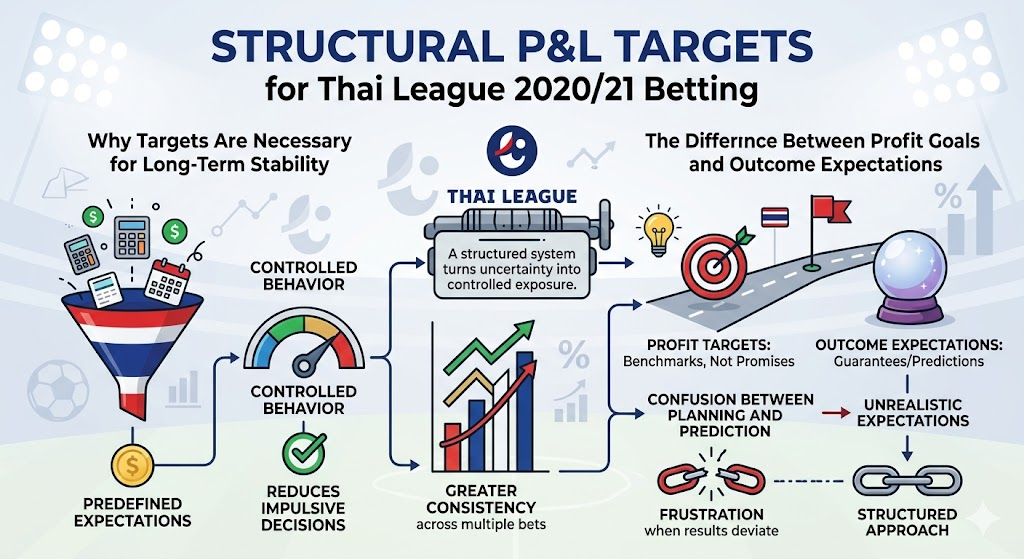
Without clear profit and loss targets, betting becomes reactive rather than planned. In the Thai League 2020/2021, bettors who approached the season with defined limits and expectations were better equipped to manage variance and avoid emotional decisions. A structured system turns uncertainty into controlled exposure.
Why Targets Are Necessary for Long-Term Stability
Betting outcomes fluctuate, but targets create boundaries. The cause is predefined expectations. The outcome is controlled behavior.
This reduces impulsive decisions. The impact is greater consistency across multiple bets.
The Difference Between Profit Goals and Outcome Expectations
Profit targets are often misunderstood as guarantees. In reality, they are benchmarks, not promises.
The cause is confusion between planning and prediction. The outcome is unrealistic expectations. The impact is frustration when results deviate from targets.
Setting Realistic Profit Ranges
Targets must reflect the nature of variance. Overly aggressive goals lead to forced decisions.
Before defining profit expectations, consider:
- Average odds typically selected.
- Historical win rate or estimated accuracy.
- Frequency of bets placed.
- Variance in short-term outcomes.
- Sustainability over an entire season.
These factors matter because they ground expectations in reality. The impact is achievable targets.
Defining Acceptable Loss Limits
Loss limits are more important than profit goals. They protect the bankroll from uncontrolled decline.
Types of Loss Limits
A structured system includes:
- Daily limits to prevent short-term escalation.
- Weekly limits to control streak-based losses.
- Seasonal limits to protect long-term capital.
The cause is risk containment. The outcome is defined stopping points. The impact is reduced exposure to prolonged losses.
Linking Targets to Bankroll Management
Targets must align with available capital. Without this connection, limits lose meaning.
Before applying any system, ensure:
- Bet size is proportional to bankroll.
- Profit targets scale with available funds.
- Loss limits prevent significant drawdowns.
- Adjustments are made as bankroll changes.
These connections matter because they maintain balance. The impact is financial stability.
Behavioral Impact of Having Clear Targets
Defined targets influence decision-making. They create a framework for when to continue or stop.
In conditions where betting activity is conducted through a digital betting destination connected to พนันบอล, clearly defined profit and loss thresholds act as a counterbalance to continuous access. This reduces the likelihood of overextension.
When Targets Become Counterproductive
Rigid targets can create pressure. This often leads to forced bets or unnecessary risk-taking.
Common issues include:
- Chasing profit targets within limited time.
- Increasing stakes to meet goals.
- Ignoring value in pursuit of outcomes.
- Treating targets as obligations rather than guidelines.
These behaviors matter because they distort strategy. The impact is reduced decision quality.
Comparing Fixed vs Flexible Target Systems
Different approaches to target-setting offer different advantages.
Before choosing a method, consider these contrasts:
- Fixed targets: Clear structure but less adaptability.
- Flexible targets: Adaptive but require discipline.
- Pressure level: Higher with fixed systems.
- Responsiveness: Greater with flexible systems.
- Suitability: Depends on individual behavior.
These differences highlight the importance of alignment. The impact is more effective planning.
Alternative Perspectives on Profit and Risk
Profit and loss are often viewed emotionally, but they are outcomes of probability.
A comparison can be drawn with systems associated with a casino online, where expected return is mathematically defined. In football betting, targets must account for uncertainty and variability, making flexibility essential.
Building a Repeatable Target System
Consistency comes from having a clear process rather than relying on intuition.
A structured approach includes:
- Define bankroll size.
- Set proportional profit targets.
- Establish clear loss limits.
- Monitor performance regularly.
- Adjust targets based on results and conditions.
This system matters because it creates discipline. The impact is improved long-term control.
Integrating Targets Into Daily Betting Decisions
Targets should influence every decision, not just overall planning.
Before placing a bet, consider:
- Current position relative to profit or loss limits.
- Whether the bet aligns with strategy.
- If emotional factors are influencing the decision.
- Whether stopping is the better option.
- Long-term impact rather than immediate outcome.
These checks matter because they reinforce structure. The impact is consistent execution.
Summary
Setting structured profit and loss targets in Thai League 2020/2021 betting provides a framework for managing risk, maintaining discipline, and avoiding emotional decisions. By aligning expectations with realistic conditions and integrating targets into daily decisions, bettors can create a more controlled and sustainable approach.
